Deal or No Deal is clearly America’s newest game show fetish. Hell, if it can bring Howie Mandel back from the throes of irrelevance, then it’s obviously captured the fascination of the public. Regardless, I have to add my name to the list of people who are hooked on this new TV chew toy, but I’m convinced that my love for the show is reflective of some kind of masochistic tendencies that I must be suppressing.
Let’s face it: it’s pure agony watching someone turn down hundreds of thousands of dollars in hopes that they’ll make more, only to watch them get burned in the end and settle for far less than the amount that they already turned down. Despite that, playing the risk/reward game with such large sums of money is enough to catch anybody’s attention, and I think people in general are attracted to games of this nature (Vegas, anyone?).
Last night’s show was extremely interesting because one of the contestants appeared to make the biggest bonehead move imagineable given her situation. Here was her scenario:

She had 5 suitcases left that contained the following amounts: $100, $400, $1000, $50,000, and $300,000; and the banker offered her $80,000 to quit. Deal or no deal, miss thang?
Unbelievably (to me, at least), this dumb woman, at the behest of her equally dumb husband, uttered the words the audience was just dying to hear: no deal. In a beautifully ironic fashion, the very next suitcase she opened contained $300,000, thus reinforcing the idiocy of her severely misguided decision. And of course, the audience offered up the oh-so-sympathetic and stereotypical “Ohhhhhhhhhhhhhhhhhhhhhhh.”
Don’t get me started on the studio audience…They remind me of a bunch of yahoos standing around a keg chanting “Drink! Drink! Drink!” while some socially inept reject tries to pour as much beer down his gullet as possible in order to attain five minutes of superstar status.
A closer look at the game within the game
While watching last night’s show, I had this intrinsic feeling that the woman just made a hideous decision, but at the time, I hadn’t come up with a mathematical reasoning to back my feelings. It was one of those gut instinct things that you just kind of know…ya know? This morning, however, I figured I may as well look into the math a little more just to see if I was correct in my opinion.
Oh, and I sincerely hope that one of you make it on the show someday so that you can use my “Deal or No Deal Strategy Guide” to your advantage. Anyway, on with the numbers…
If you consider only the suitcases in the scenario outlined above, then there is an 80% chance you’ll walk away with at least $30,000 less than the offer that’s currently on the table. Then again, you always have the banker in there as the x-factor, so that argument represents a worst case scenario. For me, this isn’t quite exacting enough, so now we need to look for a more defined strategy.
Enter probability theory, and more specifically, the value that you can expect to earn based on the number of remaining suitcases and their associated dollar amounts. Not surprisingly, this is astutely named - wait for it - the expected value.
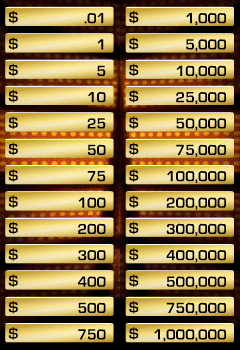
At the beginning of Deal or No Deal, the contestant is presented with 26 suitcases that contain the amounts shown in the previous image, and the expected value can be calculated from the following equation:

If no cases have been opened, then this value computes to approximately $131,477.54.
You mathematicians out there will already have noticed that the expected value for Deal or No Deal is simply the arithmetic mean, or more simply, the average dollar amount remaining in the cases. Risk aside, accepting a “deal” for less than the mean should generally be regarded as a gutless, weak decision, and the contestant should be ridiculed accordingly. However, late in the game, if a savvy contestant were to wrangle an amount out of the banker that is greater than the mean, then he or she ought to be carted off stage like Mike Ditka after the ‘85 Super Bowl.
Okay, so maybe that’s a bit of an exaggeration, but I invite you to look at things in a purely mathematical light here. If you don’t consider “luck” to be of any help to you (and you shouldn’t - although I see you over there with that scratch-off lottery ticket!), then when you begin the game, your goal ought to be to “beat the mean.” Obviously, the mean changes as suitcases are removed, but regardless of the mean at any given time, your goal should remain the same: beat the mean.
Let’s say that you got unlucky and blew off the 13 most valuable cases on your first 13 suitcase removals. It should be abundantly clear at this point that you’re not going to walk out with a wad of cash, but you should still be expecting no less than $185.85, which is the mean. If you made it to this particular point in the game and the banker were to offer you $200, then in my less-than-humble opinion, you’d be an idiot not to take it. If you prefer facts to my freewheeling opinions, then try this on: it would be a statistical mistake not to accept this offer.
So, with this in mind, let’s revisit our woman from the scenario above. Remember her? She’s got 5 cases left that contain the following amounts: $100, $400, $1000, $50,000, and $300,000. The banker has offered her a cool $80,000 to get the hell off stage and leave in such a way as to epitomize the phrase “ignorance is bliss.”
A quick calculation reveals that the mean of the remaining amounts is $70,300. The banker’s offer is $80,000, which represents roughly a 13.8% increase over the mean. This isn’t Wall Street, but SELL SELL SELL!
Look a little closer at the reality of the situation. 80% of the remaining briefcases have at least $30,000 less than the banker’s proposed amount in them. The only guaranteed way she can do better than the proposed amount is to actually be holding the $300,000 case, because if she were to remove more cases and reveal amounts less than $300,000, the banker’s offer would likely go up to compensate for the increasing mean. Keep in mind, however, that there’s only a 20% probability of this happening! Oh, also keep in mind that the $80,000 offer is guaranteed. That’s cash money, and all bets are off! 100% chance of success…going once…going twice…Ah, forget it.
After a closer look at the numbers behind the game, it’s clear that the contestant in last night’s game made a decision that was not supported by statistical analysis. Instead of the best case scenario, which she was betting on, she actually got the worst case scenario because the next case she opened contained the $300,000. Ouch.
I haven’t mentioned it prior to now, but after that little slap in the face, the banker came back with a gaudy offer of $21,000, which was 63.1% greater than the new mean of $12,875. Looking back at this, I almost wonder if the banker had simply resorted to toying with this poor woman based on her previous decisions. Either way, the lady quickly wised up and accepted the overly generous $21,000, which represented a $110,477.54 loss against the starting mean of the game.
Statistically speaking, fewer than 25% of the contestants on the show can expect to perform worse than this lady, but then again, I guess now she doesn’t look so bad. (This comes via standard deviation analysis, which I didn’t want to bore you with)
I know it’s a game show, and I know hundreds of thousands of dollars is a lot of money, and I know how thrilling it is to go for the gusto. While statistical analysis does not really provide for “gut feeling” or “made for TV drama,” it can serve as a guide for telling you how well you can reasonably expect to do given a set of variables.
If you’ve ever been to a casino, then you know it’s never a good idea to bet solely on the best case scenario like the lady in our example. And as far as Deal or No Deal is concerned, I highly recommend that you never bet on the best “suitcase” scenario!
Fun: Put your statistical minds to the test by playing Deal or No Deal here.
348 Comments ↓
Excellent post. I’ve been wondering about the math going on behind the show, but I haven’t bothered to do the figuring like you have. Very interesting
Just played the game online. I settled for 52,000 and would have gotten 300,000 had I gone through. So hard to know
Hey, I just played it twice myself. The first time, I beat the mean but settled for $178 (I had an uncanny knack for picking all the money cases).
The second time, I refused to budge on anything less than the mean, and the banker never offered more than the mean. I eventually got down to two cases: $400K and $200K, and the dealer offered me $213,000. Given the odds, I absolutely risked the $13,000 in hopes of winning $200,000 more. Unfortunately, I was holding the $200,000 case, so that’s what I walked away with. Statistically, though, I derived maximum value from the game, so I was happy
I just played again and accepted 259,000.
I had the 700,000 suitecase.
Despite knowing all the stastics behind it, you still have to decide when to take the slight gamble over the decent upside. I can’t even imagine doing it in real life
How many cases were left when you settled for $259,000? It looks to me like $259,000, although a lot of money, was less than the mean at that point in the game!
There was one with 200, one with 200,000, and one with 750,000. Looking back I should have said no, because the mean was 300,066, but I didn’t really give it much thought.
And in the end, though these statistics are nice, you can’t exactly stop after every pick and pull out a calculator to figure out what your next move should be
Tru, I began using approximations…You had roughly $950K and three cases.
$950K divided by 3 is a little greater than $315K, so based on that analysis, $259,000 is a gross underestimation of the mean (20%).
On the other hand, you made $259K! Score!
Yeah, I think you have to consider not only the relation to the mean, but also the relation to the starting mean. You figured that the starting mean is $131,477.54. That means that the 259,000 was almost double what I had started with without working. Considering there was a 2:1 chance I would be ending up with something less, and a 1/2 chance I’d be going home relatively empty handed.
btw, your website isn’t remembering my personal info when I check the box…
Yeah, it’s still buggy. I’ll just add it to the ole’ Ta-Da list…
Item #2438.b.12.
Check!
I made 302k.
Sweet.
If only it was real money.
Cool overview - I hit you with a Digg on that one!
Just curious, as I’m not a math wiz here, but in the example you gave, using the mean is a way to compute out all of the remaining (5) cases. Shouldn’t there be another variable in the equation which calculates the odds of the next pick being above or below the mean? With 5 left, there was only a 1 in 5 chance that the person would pick $300,000 (which she did). Usually at that point in the show there’s only one suitcase to pick before another offer so aren’t the odds in her favor at this point that she’ll pick a suitcase below the $80,000 offer and therfore increase the next offer from the banker?
Either way, good article and something I’ve been curious about myself.
Pete, it’s funny you should mention that, because I had actually written an aside in anticipation of somebody mentioning exactly what you said. I actually edited the paragraph containing the aside so that it mentions the fact that the $80,000 offer from the banker is guaranteed, whereas playing the game further requires more risk (and possibly getting less than the mean, or in this case, $59,000 less than the previous offer).
Yes, it’s true that the woman had an 80% chance of eliminating a case of lesser value, but she was effectively extending her risk in the face of a guaranteed reward that was 13.8% greater than the mean at the time. Statistically, the proper choice would have been to hedge the risk and go with the $80,000, but then again, I guess that’s kind of a matter of opinion!
Excellent point. Maybe this explains why I never win at Vegas.
I played and won 101,000. If “winning hypothetically” wasn’t enough, this guy I know from college DID win $99,000 on the show! Is it too late to send in that audition tape? Ugh!
I tried to understand the show some last night, but it did boggle my mind a little. Glad you explained the odds a little so I could really appreciate what the contestants gained/lost.
Last night’s show was just about as good an example of a “statistical showdown” as DOND could possibly present.
The contestant managed to get down to three remaining cases: $50,000, $100,000, and $750,000. This put the mean value at $300,000, and the banker, after a series of woefully inadequate offers (offers that were at least 40% less than the mean - boo!), finally came through with an offer of $252,000.
Now, if you were to adhere strictly to the rule that says “anything less than the mean should be rejected,” then you can’t accept the $252,000 offer. I’ll be the first to admit, however, that this is reality; these are real people; and $252,000 is a decent chunk of money.
With three cases remaining, there was a 66% chance that the contestant’s case contained at least $152,000 less than the current offer. However, there was also a 66% chance that the mean would improve if he were to select another case! If nothing else, the paradox here is enough to drive you nuts.
Although the offer of $252,000 was 16% less than the mean at the time, the contestant said “deal,” thus ending the game. Perhaps the thought of risking at least $152,000 for a *potential* reward was more than the contestant could bear, or at least $252,000 was enough to send him home happy (understandably so!).
Regardless, the good folks at DOND always play out the game to see what would have happened, so we got to see what the contestant’s fate would have been had he continued. Here’s how it went down:
The next case he selected contained $50,000, which represented his best case scenario (although the $100,000 case wouldn’t have been that much worse - think of it as an insurance policy). The resulting offer from the banker was $498,000, which eclipsed the mean by a whopping 17%.
At this point in the game, I would have accepted the offer in spite of the fact that the $750,000 carrot was still dangling out there on a stick. Why? Because I would have accomplished the goal of the game, which is simply to beat the mean. It is important to remember that the game is about the mean and not about the numbers on the board!
This was TV, though, so at this point, Howie had the contestant open up his case to see what was inside. Amazingly, the contestant’s case held $750,000!
I’m sure he probably felt positively sick upon seeing this, but he should keep in mind that $252,000 puts him in the top 20% or so of people who play the game (assuming enough games were played to make up a good statistical sample). He still beat the starting mean of the game, which was roughly $131,000. He should feel extremely good about that.
On a final interesting note, I’d like to add that when the contestant had 3 cases remaining, he was basically in a position of risking at least $152,000. Based on the banker’s next pseudo-offer, he stood to gain $198,000. In my opinion, risking that much money is too big of a gamble, even if the odds of improving are 2 in 3. Like I said earlier, this is the real world, and $252K goes much further than $100K or less! Plus, the guy had four young kids…what would you do?
Nice blog. I found it on http://www.louisvillegeekdinner.com today.
I love the math angle of DOND. I’m hooked, even though Howie has a soul patch (which is just plain wrong). I played the online version and settled for $305,475 with 3 cases left (200, 750, & 1,000,000). I was holding the $200 case. Nice deal.
Bad deal! You had an amazing insurance policy with those huge numbers out there, and you were worth over $666,000 based on the mean! I think you sold yourself short. Then again, you’re $300,000 e-dollars richer, so what do I know?
Im a highschool AP Computer Science student who is absolutly hooked on this game. My teacher (also the AP stats teacher) is requiring us to make an advanced program using java. I’ve decided to make a version of Deal or No Deal. Problem is I cannot come up with a model or equation to estimate the Banker’s offer. This has been plaguing me for the better part of a semester.
Any suggestions or thoughts you’ve had? Any help would be greatly apprieciated
What a badass problem! I would do the assignment just for fun, but then again, I have issues.
Anyway, here’s what I’d do (this ought to suffice for a HS project):
At each point in the game, you need to compute the mean (which is based on the value of the remaining cases). In order to calculate a pseudo-offer from the banker, I would suggest establishing an inverse relationship between the number of cases remaining and the current mean. For instance, if 18 cases remain, take the mean and divide by 18. In my opinion, this offer would be grievously low, so in order to compensate, I would acutally divide by the number of remaining cases over 1.75. So instead of dividing by 18, you would now divide by 10.29.
If possible, I would actually try to migrate this divisor as the game progresses, perhaps subtracting a tenth every third suitcase (1.75, 1.65, 1.55, etc.). That way, when there are only 5 or fewer cases remaining, the offer will be closer to the actual mean (which resembles the game).
The bottom line here is that the banker is using the mean to determine his every move, and that’s precisely what your algorithm should do, too.
Hey thanks a lot. I checked it out against the online game and it was close enough. It doesnt really need to be perfect but i’d like it to be. I’m going to keep looking for that single, perfect equation.
In the mean time, that should work out. I’ll set up a link for the applet once it is finished.
Excellent…Can’t wait to see it!
I was doing some mathmatical tending on the online game, running many scenarios. They basically work straight off the average, but take a % off all the higher values (and that % lowers as the game goes on) … But that varies from the show a bit.
If you truly want to do the stats on this, I have one word for you: “Beyes”. Now that will start a riot!
Great post! I am a six sigma guru at work and deal with statistical analysis everyday… The first time I saw the show the contestant did something similar (throwing away thousands) and I haven’t watched since.
One thing to note though is that at the very beginning they have to pull 7(?) suitcases, so your expected value should start from there.
Also, unlike in Vegas, the contestants have $0 on the line… which does ugly things to the brain “ah! i have nothing to lose!”
Cheers,
Rick
Rick made an excellent, excellent point- contestants don’t actually have any money on the line. If they go home with zero dollars, they aren’t any worse off than they started, other than kicking themselves for being flaming idiots. When there’s a bag with 3/4 of a million, a bag with 1k, and a bad with $.01, it’s easy to gamble and turn down the 300k offer, because they aren’t actually costing themselves money that they would have had, if that makes sense…it screws your mind when you don’t actually have the money
Author,
You are missing a very valuable point in your example. If the contestant goes on, they have an 80% chance of picking any case besides the $300000 case. This will in effect raise the next amt greatly. Not that Im saying they made the correct decision, but I think you missed that point.
Last night a girl had 100, 500, and I think 25k. They offered here around 9k and she accepted. She made the right choice, but she did horribly in the grand scheme of things
I think the show’s producers would like you to believe that people are always playing for tons of cash, but the normal statistical distribution indicates otherwise.
Independent of her decisionmaking, that lady’s final result is somewhere between the 20th and 40th percentiles, so it’s really not as “horrible” as it looks.
She just happened to be a statistic on the lower end of things.
You can’t fight the statistics - all you can do is hope to beat whatever mean you end up being presented with late in the game. If that’s $500K, great! If it’s $180, go get you a nice dinner and some wine to forget about your less-than-stellar appearance on DOND.
Brilliant analysis! I hope you and your readers continue to make observations about the show. I think Howie does a great job as the host; but what’s the probability that he will actually shake someone’s hand? Purportedly, Howie suffers from Chirophobia or Hand Phobia; or some other social/anxiety disorder . . . Howie: Shake or No Shake?
I watch the english version of the game over here. Im surprised no one has mentioned any thing about the “switch” option often presented at the end of the game by the banker.. Do you get that in the american version?
If we do, I’m not familiar with it.
First off, I will point out something that should be obvious to anyone, that has seen the show and played the online version. THEY ARE NOT THE SAME! The online game uses a different equation, for the ammount offered.
It should be obvious, because the show usuall offers about 10K for the first offer. While the online version tends to offer about 25K for the first round.
Second, I am only familiar with the U.S. (NBC) version of the game.
[now that we have that out of the way].
The poster, DigDug, is correct. They are offering the contestant a % of the average. In the beginning, the % is low (about 10%). At the end (with 2 numbers remaining) the average is 100%.
You can confirm this rather easily. Look at the first offer, and then look at the offer, with just 2 cases remaining. Its rather simple.
For example: if the average of the remaining ammounts is $100,000, then the offer will be $11,000 (after the very first round).
But, at the end of the game, if the average is also $100,000, then that offer would be $100,000(100%)
See the difference? Your offer jumped from $11,000 to $100,000, dispite the fact that the average of the remaining cases was exactly the same.
In short, the producers of the show, want the contestant to keep playing. ANd they tempt them with better and better offers. I mean, really, who is going to settle for 10% of the average?
Somebody worked this out (sorry I dont have a link), and they figured it was something like 11% for the first round offer (im talking about the TV show remember). The next offers are something like 15%, 23%, … all the way up to 100%, for the final round.
The % does NOT increase steadily. It increases only slighly in the beginning. But more drastically later. The second round is only 16%` (roughly).
You should not settle for any of the early offers, if you can help it.
There is one round, (I dont remember which exactly, sorry)the offer goes from 39% of the average to %60 or 65% of the average. It is the biggest jump in the game. And as soon as you see that jump, it would be a good idea to seriously consider making a deal.
The % of the offer, will continue to increase, all the way up to 100%. But by now, you are in serious danger of knocking out your highest cases (since you only have 5 cases left).
You’ve got a 40% chance of eliminating one of your 2 highest ammounts, at this point. That is not a chance I would want to take.
And thus, for me, that is when I would deal (if I made it that far).
Thanks for making this!
This has helped me, I’m supposed to be making a deal or no deal game using HTML and javascript. For my computor programming class.
Thanks again!
there are two important factors in playing. That is the mean of the dollars left but also the median value (middle value when arranged in order). You start with 131 k in average but the median is between 750 and 1,000.
The problem with just looking at the average is you are tempted to play the odds. If I was to offer you $200 k or a 1/4 chance of a million, you are crazy to take the chance unless $200 k is not big money to you. You lose 3 out of 4 times going for the big money.
My strategy would be to look at an average case and worst case senario and see what the dollars look like. In the case above, worse case says you pick the million essentially losing the whole 200 k offer. Average case says you pick a low number, then have a 1/3 chance of winning a million. Call it a $300 k offer. So you are risking a million to win an extra 100 k.
In the dumb lady example you started with, worse case is she picks 300 k and gets an offer around 12 k (risking 80 - 12 = 72 k) to win. Average case says she goes down to 4 cases with maybe a 90 k offer. I think she risked 72 k to win about 10 k.
First time I played that flash game I won $392,500 - with a screenie to proove that I should have been on the show.
http://rynoweb.com/files/dod_ryno.jpg
Nice article, but I’d also like to figure out how they’re figuring out their offers because it doesn’t seem to follow an exact equation - at least not one I can see.
I just played once, and i won 500,000. It came down to 200,000 and 500,000 the bank offer was 243,000. I figured what the hell, ill take the chance of losing the 43,000 and i ended up winning 500,000. this is a game of luck and gamble
>> Obviously, the mean changes as suitcases are removed, but regardless of the mean at any given time, your goal should remain the same: beat the mean.
You have a point but you’re missing something important: opportunity cost. Playing DoND is a once in a lifetime event. If you could play the game over and over again as many times as you wanted, then it would be wise to accept any offer greater than the mean. But you can only play once.
In light of this, some people might choose to accept the first six figure offer (as Howie says, “a life changing amount”). Others might have an opposite view and risk it all to win $1 million. The math certainly is relevant but you cannot discount the human factor. And that is what makes the game so interesting to watch.
There are bunch of guys from a dutch university (ERASMUS univ., BTW, the company ENDOMOL whic produces the show is a Dutch Company), who wrote a paper on DOND. The paper is on SSRN website. You guys are really close. Here is the real deal
Bank offer = fn(mean of the remaining amts, round #(1-9), luck factor of contestant at that round)
Luck factor = mean of the remaining amts/mean at the start of the game
which basically says, if the luck factor is 1, then you are neither unlucky or lucky at any given round.
They basically divide reward with more than average, after 5 or so rounds if the guy is unlucky, but award less than average if the luck facor is greater than 0.5.
Hope this helps.
deal or no deal can be a no brainer once you reveal some important cases only if you have the power over greed to accept the deal you,ll come out ok ,follow your hunch not what the audience scream out what the hick do they have to loose,know when to hold,em when to fold ,em and when to run with a decent offer from the banker
SWEETNESS THET WAS COOL
this was so cool i won the million
Yehey! Aus na system ko! Thanks! ^_^
your analysis is right on.
I think there is a screening process for the game where mathematicians are blockedout. The profile they want is low IQ and high energy. I suppose it makes for good tv, although I, like yourself, can’t take five minutes of the show.
Lets Play! Game on!
Game ON!!
I can’t wait 4 my first ame i’ve been playing on the bigbrother game Deal or No Deal and dat is shocking!!
OK…I have small six dollar bet on the line for the answer to this question….please limit your logic in the figuring of this answer to the question asked…not a bunch of hypotheticals…
When you pick the box, you are 25 to 1 to win the million.
Once they have shown you the 24 boxes proving you have the million dollars in one of the last two boxes…
are your odds of winning the million different now from the original 25 to 1…
I have many interesting thoughts on the matter…but will await responses…
the key question is —– you have to win the million….throw out any discussion of strategy or offers….I only want to know about the odds of winning the million dollars….
At the start it is clearly 25 to 1 . . . . but with two left, is it now 50 50 ???
please elaborate your thoughts….
Jim,
Assuming you don’t know the outcome ahead of time (eg. you don’t have a time machine and couldn’t possibly know that it would get down to two cases…), the probability of you having $1 million increases with each non-million-dollar case that opens. It has to change because you are not placing the cases you picked back into the pool you are picking from.
Obviously, the probability of getting $1 million goes to zero if you open any case other than yours and it has the $1 million in it.
However, if you hitched a ride with HG Wells to the future, you need to change your perspective on the probability.
If you already know, before picking any case, that it will get down to 2 cases without the $1 million showing up, right from the beginning, the probability of you winning the million dollars is always 0.5 (or 1/2 or 50 50 or 50%…whichever way you want to state it)….because, right from the beginning, you are guaranteed to hold one of two possible cases that have the $1 million.
But to clearly answer you last question, with two cases left, your odds are 1/2 that you hold the $1 million dollar case.
Ok, rip on me if i’m wrong (and i didn’t read every single post) but -
Whether or not the offer is above or below the mean isn’t really what determines whether or not taking the offer is a good or bad decision. For example:
You are down to two cases. One is $.01 and the other is $1,000,000. The mean, unless I’m wrong is $500,000. If the offer is $400,000 do you take it? How about $300,000 or $200,000? I’d be bummed that he didn’t offer me the mean but if he offers me $300,000 I’d be inclined to take it. Reason being. That is 100% chance that if i say deal I take home $300,000. But if I say no deal then I have a 50/50 chance of getting a penny. A penny won’t help me out much. And maybe people think I’m stupid and I don’t get good job offers anymore. But I could say, “It was $200,000 below the mean. I had to say no!”
The point is I dont think you really ever play for the $1,000,000 on this show unless it’s like down to two cases and they are 1,000,000 and 750,000. Then you can say well…the offer maybe 875,000 but what the heck - No Deal. because if you are wrong you are only losing about 15%?
What do you think?
Blake,
You’re describing a pretty extreme circumstance, and in that case, the banker’s offer would likely exceed $600,000. That said, I would take the offer, especially given that it’s so much higher than the mean.
Based on the show’s history, you can pretty much rest assured that the banker’s offer would exceed the mean in the scenario you described.
I played the game last night online. Maybe they use a different formula to come up with offers online vs. tv, but it was down to 500,000 and 1,000,000 and for what ever reason the bank’s offer was only $532,000. Odd i thought. In terms of life affecting, the difference isn’t enough not to say “no deal” and go 50/50 for the million. This I did, but my case held the $500,000. So I bet wrong.
But the point is… imVERYho, it really doesn’t matter if the offer is above or below the mean or by how much. That’s not what makes your decision “good” or “bad”. That’s not what you should be analyzing each round. Figuring out the mean is only useful in predicting what the banker’s next offer will likely be if you say no deal and your high valued cases are pulled off the board. (You can pretty closely predict what the banker’s offers will be without formally figuring out the mean in your head.)
What you should be thinking is, “what are the odds that my high cases will be eliminated this round?” Thus whether the number of cases to be eliminated in the next round exceeds or is equal to the number of high valued cases left on the board. (This is why Howie is always talking about having a backup) This is especially more so the case when the offers move into the “life changing” amounts which most people aren’t offered in the first rounds. (Imagine if like you said the mean before the game starts is 130,000 and before you even picked your case they offered everyone 110,000. Well this would be a pretty boring game as I bet most people would just say deal. Wouldn’t take long for them to go bankrupt. What they’d burn through 15 people a show? 1.5 million per…ouch!)
So examples:
It’s down to 3 cases, and one case will be removed,
the board shows 500,000 10,000 and 5,000. the mean is about 172,000. I’m not going to play it like…well if he gives me 180,000 I’ll say deal, but 115,000 i’ll say no deal. If he says 115 it would be very hard for me not to say deal. I mean any amount that is considerable considering my economic position in life. it would be very difficult to say I’ll pass that up the guaranteed 115,000 for a 1 in 3 chance of getting 10,000. The less risk averse out their may feel differently.
If there are only 2 high amounts left on the board and in this round you 5 cases will be removed if you say no deal, well it would take a lot of thought not for me to say deal, because no matter the mean, if those 2 come up well, you are going home not much better off than when you arrived. You see my point?
Its more playing the odds than playing the mean.
And unless I’m in a situation where i’m presented with two closely valued cases at the end, i’m never going to play to the last case based on the banks typical offers, as long as the amount is economically significant to me.
So for your ex. at the beginning 5 cases, only one high valued amount, her mean drops significantly if you have bad luck ….(that being the appropriate term when you have a 1 in 5 chance that the high value doesnt get removed and it does!) But people will look at their odds and say I’ll go for it! Some win, some lose, but if your goal is giving yourself the best chance to go home with a significant amount of money you take the deal.
In this game I don’t believe a rocket scientist has much of a better shot than the average person. Luck determines if you “beat the mean” of the initial 131,000. You can play online numerous times to the final game and never be offered over 130,000. So if you’re a genius and your big numbers get eliminated early…your screwed just like the rest of us would be. Luck sets the ceiling on what you can win. Playing “dumb” reduces that amount. But dumb is sometimes only revealed when the case is opened. If she played til the last case and it had the 300,000 then she could say…it’s better to be lucky than not dumb. (I guess that’s where “dumb luck”
comes from
So to recap.:
Continue play as long as your backups exceed the number to be eliminated.
And the mean seems only useful for 1) predicting what the next offer will be if my highest valued case is removed, 2) the banker, coming up with that figure, and 3) for the producers in determing if the show gets green lighted…(on the assumption that your average pay out per show will approach the mean as long as you have a high enough number of shows.)
Does that make much sense? I hope it does. Because if not, I have carpultunnel(?) for nothing.
Brian had it right, but no one seemed to notice. Let’s take another look.
She had 5 suitcases left that contained the following amounts: $100, $400, $1000, $50,000, and $300,000; and the banker offered her $80,000 to quit.
You are comparing the mean value (what you can hope for in your case) with the offer. This would be fine if the offer were only extended once. However, this is not the case. Yes, she only has a 1/5 chance of having greater than the offer in her case. But that doesn’t matter yet, because she can’t take the case anyway. What matters is the option at hand: should I continue? Basically, how will this choice impact my next options. Her 20% chance of holding better is irrelevent. What matters is that she has an 80% of her offering going up next time. She happened to lose the 300k, but this was unlikely, wasn’t it? It’s more likely that she’d pick one less than the offer, causing the next offer to be higher. The real consideration is whether the mean is likely to go up or down, as that’s what determines the next offer. If you make it to the last round, compare the offer to the mean of what’s remaining, but this isn’t important until you reach that point. You have to make every decision as if it were a unique opportunity. If I told you that I’ll give you $100, but that I’ll make you another offer if you say no that has an 80% chance of being higher, you should take the offer. You’re forgetting about all of the offers that will come before you actually have the option of walking away with your case. As a disclaimer, I’ll point out that this is if you’re are trying to statistically maximize your take-home. If you need $50k for an operation, you might not want to risk it. I’m just looking at the numbers.
You may want to look again Josh. Actually, Brian’s point was dealt with in my last post when I said, “….bad luck (that being the appropriate term when you have a 1 in 5 chance that the high value doesnt get removed and it does!) But people will look at their odds and say “I’ll go for it!”
I thought you were going to say what I thought, but then you went in to things like “life-changing amounts” and other considerations. I just wanted to deal with the mathematics in detailed terms.
If you can beat the mean at any point in the game, why wouldn’t you? First, you’ve completed the objective of the game (which is to beat the mean), and second, you walk away with guaranteed cash.
Statistically speaking, the banker rarely offers an amount greater than the mean, and when he does, you ought to take it. You’re not going to get many chances to actually beat the mean, so when that opportunity presents itself, I think you ought to take it.
In the example from the post, the banker’s offer exceeded the mean by 13.8%, and statistically, almost nobody beats the mean by that much in Deal or No Deal.
She should’ve accepted the offer and gone home.
Since when was the goal of the game to beat the mean? The goal of the game is to maximize how much money you take home. You’re looking at what the end of the game might be instead of considering the decision at hand. She had a 20% chance of having more than the offer in her case, so it would be statistically unwise to bank on that. However, she had an 80% of her next offer being higher. You have to make the decision youre faced with. SHE WASN’T CHOOSING BETWEEN THE OFFER AND HER CASE. SHE WAS CHOOSING BETWEEN THE OFFER AND ANOTHER ROUND. Going another round had an 80% chance of increasing her offer, at which point she can decide again whether to take the new, improved offer or settle.
If you had $1, $5, $10, and $1,000,000 left on the board, you shouldn’t take an offer of $400,000, because you have a 75% chance of eliminating one of the small amounts and having a much higher offer next time. Worry about what’s in your case when you have $1 and $1,000,000 and get to choose between the offer and your case. Until you can take your case, it might as well be any other case on the stage. You have to focus on the actual outcome of your decision. When you choose BEFORE the last round, there are two possible outcomes from continuing: offer going up (good) or offer going down (bad). Figure out which is more likely and act accordingly. Most people don’t even make it to the last round, so it never mattered for them what was in there case. What mattered was the offers they received and which one they took.
My entire post centers around the fact that the goal of the game is to beat the mean. If you’re in it to take home the biggest pay check, then you are committing to relying on luck.
There’s just as good a chance that you’ll blow off the high dollar cases as the low ones, so there’s really no strategy involved there at all.
The only strategy, then, is your decision-making throughout the game.
The only criteria upon which you can reasonably base your decision (mathematically speaking and with emotions aside) is the mean. By nature, the mean shifts up and down as the game progresses, leaving you with a different snapshot of what you can reasonably expect to earn at each juncture along the way.
You cannot expect to win an amount equal to that of any of the cases. I don’t mean to be condescending, but that’s a really juvenile way to approach the game. This is because in order to pull an amount in a case, you’d have to end up with that particular case.
The only way this would ever happen is if you got lucky.
Oh, and in your comment, you argue that if you have 4 cases remaining, $1, $5, $10, and $1,000,000, you shouldn’t take the offer.
You, my friend, are nuts.
You would be an absolute fool to turn down an amount that is 60% greater than the mean.
Also, it should be noted here that the banker would never offer $400,000 in that scenario. Something on the order of $275,000 would be more appropriate.
Given that scenario, I would take the $275,000, too.
One thing you have to remember here is that $400,000 (or even $275,000, for that matter) is much, much greater than the starting mean of the game. To triple the initial mean is to accomplish something that would land you two standard deviations above and beyond most results from playing the game.
If you can guarantee yourself a place in that part of the distribution at any point in the game, you would be an absolute fool not to do so.
I just learned of this game today. Everyone obviously seems to be looking for the optimal strategy. In order to compute it, however, one would need to know how the banker deviates from the mean in making an offer. If the offer is always less than 100% of the mean, then the optimal strategy is always (from an expected value point of view) to never accept any offer. It becomes much more interesting, however, if the banker offers amounts that sometimes are below the mean and sometimes above the mean. In that case, one would need to know the distribution of (offer - mean) to devise an optimal strategy.
By the way, the above only pertains to optimizing wealth and does not take into account utility of wealth (that is, an individual would more likely take a sure $100,000 than a 50% chance of winning $210,000 along with a 50% chance of winning $0 even though the latter yields an expected value of $205,000.)
We must be watching a different show. If you want to beat the mean, go ahead and take the first offer that’s above the mean. I, for one, want to make as much money as possible. To do that, you must make sound mathematical decisions at EVERY step.
Imagine, for a moment, that you have 6 cases left: $0.01, $1, $5, $10, $20, $1,000,000. Your mean is about $167k. By your reasoning, an offer of $180k should always be taken because it beats the current mean. But what about the next mean? Can you not see that there is an 83% chance that a small amount will be opened and the mean (and therefore the offer) will rise? I’m not saying to keep your fingers crossed that you have the million dollar case. That’s unlikely. What is likely, however, is that you’ll profit by playing another round. You can settle for anything above the current mean if you want, but if I had an 83% chance of getting a better offer next time, I think I’d be a fool not to go another round.
Josh,
With each of your comments, the situation becomes more and more extreme.
It’s hard to debate an issue when the variables keep changing.
It’s hard to get you to understand, so I was trying to put it in obvious terms. It’s a game of variables. If your system works, it should always work. If it only works in moderate situations, you should state that. (It’d still be wrong, though.) A statistical system will always work, not just in situations where the numbers make your system look sensible. It’s more obvious for large ranges than small ones, but the principle still holds true. Your offers will go up if your mean goes up. If your mean is likely to go up next round, then your offer is likely to go up next round. Every choice (until the last round) is a choice between the offer and another round. What you think might be in your case doesn’t come into play until you get to choose whether or not you want your case.
You know what, you’re right.
I must be an idiot.
Why the fuck did I put up with four years of the #3 Mechanical Engineering Institution in the country?
Why did I learn statistics and other meaningless crap when I could have just listened to your clairvoyant insights?
I don’t see why you’re wasting your time at my site if you’ve got your finger so firmly pressed upon the pulse of success and useful knowledge. You should be out getting rich and writing those “rich jerk” info product spoofs.
But you don’t need me to tell you that…Right?
Wow… mechanical engineering, eh? I sure wouldn’t know anything about that. [/sarcasm] I’m sorry if I frustrated you. It’s just mathematics, and I understand that statistics can be awfully complicated. But seriously, if you have a great chance of getting a better offer next round, isn’t a system that tells you not to take advantage of that flawed? When it comes to statistics, you have to make decisions one at a time. If you miraculously flipped 30 heads in a row, you’re still only 50% likely to flip tails the next time. Each decision must be made independently, considering only the choices at hand and the possible results.
And before you flaunt your education, you probably ought to know where I went to school, what degree I received, and what GPA I earned.
I forgot to answer your question as to why I posted in the first place. I find the show interesting, but I disagree with your analysis. I thought I’d weigh in. I’m sure most of the readers are capable of reading both points of view and deciding.
Well, Josh, I could do that…
But you see, I really don’t have to, because you’ve revealed quite a bit about yourself here in the comments.
You have continually spoken about “mathematics,” and yet you’ve offered no insights of any statistical relevance to combat the equations, methods, or reasoning that I supplied in the post.
Moreover, you have also displayed a “shoot from the hip” kind of attitude with your arguments, which are very much impulsive and not backed by any sound resources. I say this for a variety of reasons, but most notably because you seem to think that the banker routinely offers amounts greater than the mean.
The reality here is that a majority of players never even get an offer that is greater than the mean unless four or fewer cases remain. In fact, most of the offers leading up to the very end of the game are ludicrous and not even worthy of consideration.
And, since we’re debating things here, I’d like to point out another hole in your argument. In your most recent comment, you make the following claim (smugly, I might add):
I’m really not sure what’s so telling or great about that statement, because I make it quite clear in the post that the mean changes at every step along the way. Your decision at each juncture is based on the new mean, so it looks to me like all you’ve done is restate my argument in more rudimentary terms (with a very generalized “odds” description instead of a statistical one).
So, with all that information in hand, here’s what I believe to be true about you:
To be quite honest, I thought the issue was obvious enough that it didn’t require a dissertation with bibliography on statistical theory and the game show applications thereof. I am not going to discuss my education with you. I will say, however, that my wife laughed out loud when she read your guess at it, and not because you guess well. Besides, my background doesn’t make my argument any more or less valid. That, my dear man, would be committing a logical fallacy called “Appeal to Authority.” Allow me to overcomplicate a very simple concept so you can feel better.
The game of Deal or No Deal is a series of choices. The first choice (besides a random choice of case) is whether to take an offered sum or money or to continue playing. If you continue, more cases will be opened and more such choices will be made. To appreciate the statistical implications of this game, both the choices and the possible outcomes must be understood.
Choices: Until the last round, the player must decide each round whether to accept the banker’s offer or to reveal more cases and receive another offer. On the last round, the player must decide to accept the banker’s offer or take home whatever sum is within his or her case.
Outcomes: Until the last round, a decision to reject the deal results in the opening of more cases and the offering of a new deal while a decision to accept ends the game with the awarding of the offered amount. On the last round, a decision to reject the deal results in the contestant being awarded the amount in his or her case, while a decision to accept ends the game with the awarding of the offered amount.
It is especially important to note that during opening play, “No Deal” results in a new offer. To get the best outcome, we must first define the optimal results; namely, maximizing the money the player is awarded. To reiterate, money is awarded through either accepting an offer or progressing to the last round and taking the chosen case. To maximize the award, the player must make the best statistical choice at each juncture.
When faced with any offer to continue opening cases or take the current offer, the obvious question with player must ask himself is “Is continuing likely to increase my award.” Obviously, the amount in the chosen case will never change, but the offer will. Understanding the offer is necessary, so let’s digress for a moment to discuss it. The offer is loosely tied to the mean, but the percentage of the mean that the offer represents generally increases throughout the game. We can predict, then, that an increase in the average values left in the game will result in an increase in the offer. This is paramount.
The decision to deal or not deal must be based on the outcomes. Until the last round, the outcome of accepting the amount in your case is not an option. The only possible outcomes are the immediate end of the game with the offer or the continuation of the game with the revealing of more cases. As previously stated, the player must ask which decision is “better.” Assuming that a strictly mathematical approach is used, it is easy to determine whether or not continuing is advisable. If your next offer is likely to be higher, then remaining for the next offer is the best choice. If your next offer is likely to be lower, then your current offer is the best you can expect.
As this rule seems to be in contenion, let’s examine it in more detail. Say, for discussion’s sake, that you are faced with four amounts: $200, $750, $50,000, and $75,0000. The mean of this is just over $200,000. We can predict, then, that our offer will lie somewhere near $200,000 (likely below). We can note that only one of the four remaining values is over this offer, allowing us to conclude that, at this point, there is only a 25% chance that the case we chose holds a value greater than the offer. This, however, does not mean that the current offer is the most we can hope to take home. This is obvious, if we consider what would happen if the case holding $750 were opened. The average would increase to $267k, and the next offer would increase accordingly. To determine the likelihood of this is a straightforward exercise. Three of our four options lie below the mean, so there is a 75% chance that our mean, and therefore offer, will increase with another round.
Once we agree to continue, more cases will open, the mean will change accordingly, the offer will change accordingly, and the pattern continues. At each round (not including the final round) the most statistically sound procedure is to calculate the likelihood that the next offer will be higher. If a contestant were ready to settle, accepting perhaps that his case is unlikely to hold a high value, the contestant might be tempted to accept the immediate offer or an offer “close to the mean”. If it is probable that the next offer will be higher, it would be unreasonable to accept the current offer based on mathematical principles. In general terms, it does not make statistical sense to accept a lower offer if a higher offer is likely.
The final round is the only deviation from this. Continuing the above example, consider the final two amounts being $200 and $50,000. The mean (that is, the expected value) is $25,100. At this point in the game, the choice is finally between your offer or your case. Again, from a strictly mathematical point of view, any offer above or equal to $25,100 can be accepted, and any offer below or equal to $25,100 can be rejected.
The difference between this method and the method described in the original post is that this method takes into account the circle of case revelations and offers, whereas the original recommendation simply weighs the current value against the value that can expected in the first case. There are more opportunities for profit than cutting losses or taking your case. Accepting the optimal offer should be a part of any analysis.
—Well, that was lengthy—
I apologize to those of you who prefer less… academic descriptions. To summarize once again, it doesn’t make sense to accept an offer if your next offer is likely to be higher. Even after you have given up on a jackpot pocket case, you can still determine when the best time is to accept the offer. If your next offer will be lower, cut your losses and take the deal. If your next offer will be higher, why would you accept the offer? Even common sense would dictate that a 75% chance of a better following offer is something you should take advantage of.
In most scenarios in this game, the average payout is significantly greater than the median. I believe my strategy would be to be mindful of the median, and take the deal when the offer was a significant percentage of the the average. I would accept 60-80% of the average. Of course, if I was lucky, I raised the average by revealing low-dollar cases.
I WON THE MILLION!!!!!!!!!!!!!!!!!!!!!!!!!!!!!!!!!!!!!!!!!!!!!!!!!!!!!!!!!!!!!!!!!!!!!!!!!!!!!!!!!!!!
Josh, I think you misunderstood my statement. You are correct that to make the most amount of money you should accept an offer above the mean. When I stated that one should never accept any offer it was under the assumption (as someone else had stated and as I have never seen the show, I don’t know it it’s true) that the offer was always less than the mean.
If that is not the case then things get really interesting. Suppose that (offer - mean) is symmetrically distributed (e.g normal). Then you would expect as many offers above the mean as below and deciding whether or not to take an offer gets complicated as it becomes a function of both magnitude (above the mean) and number of offers remaining.
It reminds me a little of the famous Secretary Problem (see http://en.wikipedia.org/wiki/Secretary_problem).
So basically, to devise an optimal strategy, one would like to observe and, if possible, figure out the distribution of (offer - mean).
Sorry for the confusion. I was not responding to you but to Chris. I’m not sure what the distribution of offers looks like, but I know that there is a general trend for the offer to mean ratio to increase during the game. It has been known to pass 1 (offer being greater than the mean), but it is usually much lower at the beginning.
i want to know if any one has actually sat a tried to figured out what are the odds of what money is in what case like how many times the million is in case number 5 for example i would love to see those stats
so my last post only displayed abut a 1/5 or 20% or 0.2 or 1:5 of what i actually typed. but when it posted and only the first paragraph showed up, i figured, what ever.
but today i read more posts..and i noticed how mean they were. i mean, really, can’t we be more civil and treat people respect, as ends, and not simply as means to display our superiority to the word? i mean to change the tenor of this debate, meaning, to get back to the true point of the discussion, i.e., how to improve your chances of going home with a mean wad of cash. you know what i mean? but i guess its easy for the “average” joe to become fixated on the mean.
First, i agree with josh. beating the mean isn’t the point of the game, in any individual round or for the game as a whole. i know on first glance it seems to make sense, several scenrios have shown why this not how you should play. this is the simplest. beating the mean is simply havig an offer that is greater than the average. this could mean beating it by $1. under his rules if the offer is $1 greater than the mean you take the deal. it is not forward looking and doesn’t take into account what your odds will be in the next round. he buffers his theory by saying in the final rounds the offer will always be above the mean…and that any example where the offer is below the mean is unlikely or extreme. but this means accepting every offer in the final rounds. what is the point of saying take the offer if it is above the mean and refuse if it is not, and, by the way, it will always be above the mean in the final rounds thus you should always take it. if simply beating the mean is the point, and in the course of the game you passed up offers in the tens and hundreds of thousands that were unfortunately below the mean, but you accepted the final offer of $60 because only the $10 case and the $100 case remains, and $60 is above the mean, that you ‘won’ the game. i’d say, “wow, really? i guess i really aren’t so smart. cause i thought you lost.
again if the bankers offer was 400,000 and it was down to the $1 and 1,000,000 cases, chris’ rule says refuse. i know you say that that the offer will always be greater than the mean in that situation. that is very convenient for your rule, but doesn’t make for an interesting theory. utilizing your strategy for the above situation: 499,999 offer - refuse…500,001 offer - accept. your rule is absolute, mine is relative. mine says, for most people in this situation, if the offer is 400,000 or if it is 600,000, there isn’t much difference in how you formulate your decision. don’t be greedy, play it safe, take the deal and be asured of going home with a lot of money. I know its only equivalent to a weeks work or less for an MIT graduate, but that is alot for the median american family.
as for Josh’s theory that simply says play as long as the odds that the offer in the next round goes up…well that is nice..and may be more useful than Chris’ mean theory, however it doesn’t hold either. Here’s why. You have a situation where you only have 1 high value case and several very low value cases. the odds are in your favor in every following round that the odds will go up UNTIL the offer goes down, and then at that point who cares. The offers will tiny. 1 high, 6 low- odds in your favor. 1 high 5 low - still in your favor 1 in 4, 1 in 3, and 1 in 2. can you stomach playing 1 in 3 knowing that if your high number comes up, you go home with basically nothing? the odds are in your favor, your rule says play on. but how far do you push your luck when the odds of the offer going up are in your favor? if those 3 cases are 1,000,000 100 and 10, chris’ rule says stop if the offer is over 335,000 but play if it is 330,000. so that wouldn’t help me either.
obviously both strategies are flawed. but man, all this “i went to MIT” blah blah blah. i hate to break it to you, there is a bell curve at MIT too. ptolemy and marx proved no matter how intelligent you are, no matter how complex your theories and models are, if your basic premise is wrong, well what’s the point. throwing all your statistical tools ( i heard a lot of mention of them, but i didn’t really see any actually used) at a faulty premise, just tells me you should know better.
your use of the expectant value formula looks impressive. most of us see that and say wow, this guy is out of our league..but it just gives you the average, something we learned to do in grade school.
i can’t wait to read your scathing and viscious attacks on my meager third tier intelligence. i hope you back them up with logic, mathematical or otherwise.
Guys, I never said this was a hard and fast rule.
The best you can hope for in the game is to beat the mean. You can’t plan on only removing the low dollar value cases in the beginning — case removal is completely about luck.
The only element over which you have any control is offer acceptance, and I’m saying you should never accept an offer that is less than the mean.
Obviously, if you have a case scenario where you can risk $80,000 to make a $200,000 upswing, then you take that risk, even if the current offer is greater than the mean.
But, in most of the scenarios described here, people are risking $200,000 with the hope of making about $60,000 greater than the current offer.
When the risk is less than the reward, only then do you decline an offer that is greater than the mean.
If the risk outweighs the reward and you decide not to accept an offer that is greater than the mean, then you’re playing with fire.
I hate luck, and Vegas has put it to me sans-vaseline on many occasions, so what I’ve suggested here is the way to play the game with the least amount of risk.
I like your theory. I just wrote a program to play along at home and was looking for others’ thoughts on the math.
I will be testing my formualas for a while…
But, unfortunately this is not a mathemetical issue for the players.
There hasn’t been one player yet, I bet, who could calculate the average of round 2,3,4,5 or probably 6.
So If I were a player in the real game, I likely would be swayed by what I ‘thought’ my odds were.
Now the ‘game is on’. It is the ‘banker’/stats against lil ole me and my amateur ‘card counting’ skills.
Therefore while the producers’/banker’s goal is to ‘win’ by hedging against the mean with ‘nice offers’ for the poor suckers,
the players goal is to decide whether the offer is better than what they ‘think’ their odds are of increasing the offer.
The reason the offer is on par with the average when you get down to the last rounds
is that it makes it appear that the offer is ‘obvious’ to those folks at home that can do basic math
Most people will never know that the offers were less than any mean/avg.
Most people will never even think about the the offer being less than the mean because they believe that
it is all in the ‘odds’ which no one really understands.
They will say -’Of course the offer is small in the beginning. They want you to play on.”
or “the odds are still small at this point”
At any rate, although the average at the start is ~131K, that is not the players starting point.
The players starting point is the first offer and you will never get an offer even close to the mean until
the 4th/5th round. At that point it could theoretically be too late for some poor players with bad luck.
just my POV.
would love to have a go
The end-game scenario presented can be approached in one of two ways. Clearly, taking the $80,000 offer in light of only one larger amount being available crushes the mean. The other angle, however, is that the percentage of picking something other than the $300,000 case was very much in her favor - either 75% if she had not already chosen the case as her own unrevealed prize, or 100% if she had. Given that elimination of a lower-level amount would likely have brought the next offer to something approaching, but just under, the arithmetic mean, it boiled down to no worse than a 75% chance of winning around $140,000.
That said, I don’t know I’d be willing to place an $80,000 wager on even a 75% chance…
Great game show for math junkies!
-dw
I wrote a vb express prog to calculate the mean value, it only seems to become correct as the game progresses…have a look fellow programmers tell me what you think
http://www.freewebtown.com/ryandebraal/dealornodeal.zip
Tonight’s game was another example of why the simplistic mean strategy promoted by chris p. and the odds strategy promoted by others just don’t make sense. the guy had a great board $75k, $100k, $400k, and $750k. but as he told Howie, he was greeeeedy. and greed took him down. now as i remember the offer was $261k (maybe $281). either way, well short of the mean (or expected value) of $341k. so according to chris p. - NO DEAL! and the odds that the offer would have gone up were in the 75% range, based on typical offers, as the game approaches the final 2 cases. so the odds players advice? NO DEAL!
now being the lowly community college graduate that i am, i looked at the board, looked at the not-tooo-unlikely worst case scenario, and looked at the offer and said- DEAL! (but hey, i’m dumb and couldn’t get into a top 3 engineering school
or a second tier business school, dang it!)
well, next pick $750K. Awwwww! offer: in the 130’s. well below the mean again. and - NO DEAL!
next pick- $400K - Ooooh! Greed is good….Beat the mean! that’s the point! offer - $87K. well that’s pretty close to the mean but not quite. and what the heck right? n0 deal…
his case had the $100k in it. wait, the mean of his last 2 cases was $87,500… he did it! he beat the mean! woo hoo! he beat the mean!!! $161k less than his highest offer, but he beat it!!! That’s the point right???
Blake,
It’s not a mindless strategy. I saw the guy last night, and considering the four cases he had remaining — $75K, $100K, $400K, and $750K — I certainly think he did the right thing by electing to pick at least one more case.
The offer of $261K, which was well below the mean 0f $331K, was unacceptable. Typically, by the time three or fewer cases remain (especially if they are high-dollar cases), the banker will crack and come through with an offer that is well above the mean.
There is a very no-nonsense way to look at the risk involved in this scenario, so let’s check that out. The following bullet points illustrate the possible scenarios from the worst case to the best case:
Now, in order to determine the next move the man should make, we have to evaluate each of the scenarios above based on its risk.
Based on the worst case scenario, the man is risking $70K in an attempt to make more money. There is a 25% chance he’ll lose $70K, a 25% chance he’ll gain $47K, a 25% chance he’ll gain $147K, and a 25% chance he’ll gain $155K.
My own personal philosophy is that, while playing the game, it is not a good idea to risk more money than you stand to gain at any given time.
In our scenario here, the man was right on the fence. 50% of the time, he was risking more than he stood to gain, and 50% of the time, he was guaranteed to more than double his investment (which is his risk). All told, there was a 75% chance he was going to make more money, but I would only consider his investment to be “solid” 50% of the time — still not bad odds for such huge sums of money!
At this point, though, it’s a personal decision — do you walk away from the game when there’s a 75% chance you’ll make more money? Do you accept $70K less than what you’re worth at the time?
Would Terrell Owens play for a team that wouldn’t offer to pay him what he’s worth?
Seriously, though. In this case, you could argue that any choice is the correct one. Statistically, it’s reasonable to continue playing the game. Obviously, it’s also reasonable to walk with $261K, because that’s a hell of a lot of money.
If it had been me up there playing the game, I would have elected to choose one more case, just as the man did in last night’s show.
Unfortunately, he removed the $750K case and was then offered a measley $144K, which was $47K below the new mean of $191K. Again, I would have removed one more case and ended up just where the man did last night — walking home with $100K.
A lot of folks have a hard time believing that this scenario is a positive outcome, especially since the man could have gone home with $261K. The fact of the matter is that you cannot control luck in the game, and unfortunately, the process of removing dollar amounts is pure luck.
It’s not fair to look at these situations in retrospect, because there’s no way to predict these things during the decision-making process (and of course, hindsight is always 20/20).
The bottom line for last night’s game is that the man had a 75% chance to gain more money (and a 50% chance to double his “investment”), and he elected to do so.
This decision is both understandable and supported by the underriding statistics, so it’s not reasonable to say that the man made a poor decision.
It’s like getting a bad beat in poker — the poor guy last night just took a bad beat in Deal or No Deal, and that’s the way it goes.
[...] Here’s the thing about Show Me The Money, conceptually its good. It’s not as good as Deal or No Deal. [...]
chris,
your last post is closer to the mark. but you’re exactly right, it is a game of luck. as i said earlier, luck provides the ceiling for your potential maximum winnings. however the real point is, how far do you want to push that luck.
i haven’t followed the game enough to be sure…and maybe you have all the games tivo’d and can go back and do the math, but i believe i have noticed a trend where the majority of those that go home with significant money tend to leave money on the table. meaning they often accept deals where the odds that the next offer will go up are still in their favor. and, by the way, offers that are below the mean, no less. losers tend to push their luck and go home with a fraction of what they could have if for not being quite so mean and greedy. (ok i beat that to death.)
to keep beating the horse that is dead, in a 1 in 5 situation, where there is one high and 4 low valued cases…chances are that you won’t pick the high case, but chances are that you also aren’t holding the high case, meaning that chances are that the high case will be removed in subsequent rounds before you get to the 50/50…so how far do you feel comfortable taking your chances. it seems most feel comfortable until they get to that 1 in 4 range. josh feels comfortable playing as long as the odds are in his favor (which is every proceeding round until the high case is removed) until you ultimately make it to the 50/50 ..your worst possible odds in this scenario. again…things are not quite so serious if you have back-up high cases. back-ups, back-ups.
anyway, the banker must be reading your blog, and be convinced that the contestants are as well, because the banker “forced” that guy into “No Deals” with “unacceptable” offers. not only was the $261 well below the mean… but the following offer of $144 was well below the mean again. he was forced to take it to the river.
this isn’t even an extreme example…he had a good board and was guaranteed to go home with money. the point is that basing your decision on the mean in order to remove luck from a game that is based on luck, simply isn’t the best strategy.
compare your last post with your previous posts. it’s nice to see you are coming around. now your modified strategy, outlined in that last post, is closer to a usable strategy by incorporating the odds. i’m not saying the mean is meaningless, it’s helpful in predicting offers, but as we’ve seen, is by no means determinant, at least not until the final round, where the offer is pretty reliably close to the mean. and the odds are helpful too…in telling you when not to push it to far.
i’ll make 2 analogies. playing russian roulette.. 1 bullet, 6 chambers. someone offers you 500,00 in the first round and will double your money each time there is just a click. ok…that’s a little extreme.
let’s use the football analogy. you like those. peyton manning is arguably the best quarterback in the NFL, he isn’t making the most money. let’s say the texans are willing to offer him 20% more, because that is what they believe he is worth…thus, the market declares that is what he is worth. (endorsements etc. all being equal). should he take it? they have about the worst offensive line in football, his career will probably be shorter. you have to take a comprehensive approach, risk also has a qualitative aspect. a lot of players accept less money than they are worth and end up having better careers (health/financial/personal) than those who don’t.
for all those people that accepted amounts below the mean, or when the odds were in their favor to continue but didn’t, i guess the downside of coming up unlucky outweighed the upside of the marginally increased offer. meaning marginal in the sense that they’d be risking the loss of a life changing amount of money (major) in exchange for a chance at a “more” life changing amount of money (not as major). sorry but i think they are pretty smart.
there is a funny little saying that goes something like this - in theory, theory and practice are the same. in practice, they are not.
Meal or No Meal - Spoof
A cheerful host and encouraging peanut gallery are there to keep the game lively with humor and the most melodious accents in the world.
http://www.priceyourmeal.com/mealornomeal
Let’s play!
Only just found this thread and I’ll comment from a UK perspective where the numbers in the boxes are different (amd smaller) than in the US.
As far as I can see, what has not been mentioned here is that the “Banker” is a person put in place by the programme makers. I have not recorded teh shows in detail to test my hypothesis, but I am pretty confident that the Banker, at least in the UK, does not follow a clearly defined and fair algorithm. One reason for this opinion is that I have seen shows where the offer has varied wildly from one round to the next and has gone from values near the mean to tiny values without good statistical cause. I watch the show with a running mean of the box values in my head and early in the show the Banker always offers a lot less than the mean.
Si, I think we need to forgetthe idea that it is a ‘fair’ show in the same sense that a roulette wheel should be fair. Nonetheless it seems to me that as soon as the offer exceeds the expected value, this should be taken, not least because, in the UK version, most people could happily walk away from deals much below the game’s opening expected value of around £15,000 (if memory serves). I think then that anyone being offered £20,000 should take it on statistical grounds, and anyone offered much less than £15,000 might as well play on even if the odds are declining.
I think this shows that that the absolute value of the boxes has an impact. Most people in the US would not want to mess up winning something close to the mean of $131,477.54, whereas in the UK you need to win closer to the upper end of the possible values for it to be a “life-changing” sum in the words of the programme-makers
I think Josh and Chris together come very close to the ideal statistical strategy. Let me see if I can pull it together in a way that satisfies everyone.
First, let’s define the player’s goal. I’m going to assume that the player’s goal is to maximize his likely earnings. Not to maximize his *possible* earnings, mind you, but his *likely* earnings, using “likely” in the statistical sense. Assuming the utility of money is a linear function of its amount, and assuming the player wishes to maximize utility, that’s the most rational strategy possible.
At each decision point in the game, the player has to choose “deal” or “no deal”, based on the banker’s current offer and the money remaining on the board.
Chris says that if the offer is higher than the mean of the money on the board, the player should take the offer. Chris is right (assuming a rational banker) but his rationale for why this is right, is wrong.
Josh is right that the player’s decision isn’t related so much to whether he’s ahead of the mean or not, but whether his likely income will be increased by continuing to play.
What the player really needs to consider, as Josh says, is whether the next offer will likely increase or decrease. But the question is more subtle than just going up or down. If there’s a 60% chance of the offer going up by a small amount, and a 40% chance of the offer going down by a large amount, it’s a bad bet even if the balance of odds favor going on.
What the player needs to consider, then, is the statistical expected value of the next offer. The exact offer is unknown, but it’s some perturbation from the next mean, and we can easily calculate the expected value of the next mean, by considering each possible choice, calculating that mean, and then calculating a weighted average of all of those future potential means.
If we have some knowledge of how the banker adjusts the offers from the means, that should be factored in as well. Assuming that we don’t, though, the player is best served by comparing the current offer to the expected value of the next mean. If the expectation is that the next mean will be higher than the current offer, the player should continue playing.
That formulation is, I believe, one that both satisfies Josh’s point that the crucial issue is the decision as to whether playing on increases the expected mean or not, and satisfies Chris’s desire for a purely rational, mathematical strategy.
Here’s the interesting bit:
This is conceptually different from Chris’s strategy, but numerically identical. Why? Because the current mean equals the next expected mean. It’s easy to show algebraically, or you can just try some numbers in a spreadsheet.
So, if the banker generally sticks close to the mean then the player’s best strategy is to take any offer that exceeds the current mean, because that offer also exceeds the expected value of the next mean (and therefore the next offer).
Given that the banker is known to diverge from the mean, the game strategy really boils down to one of outguessing the banker. He’s offering a premium on this deal… will he offer a significantly larger premium on the next, or is this as good as it’s going to get? Then there’s also the human element — the fact that utility is not a linear function of wealth, and it’s a function that varies from person to person even among the most purely rational of people.
Those two elements are what make the game interesting.
Very interesting debate. Special thanks to Chris, Josh, Blake and Shawn for taking the time to distill these questions into concrete thoughts to satisfy the curiosity of a bored web surfer.
I would like to add an additional question that may help us to explain the banker’s divergence from the mean, especially in later rounds of the game.
I’ve yet to see any claim that the banker’s offers are made independently from the knowledge of what is in the “pocket” case. That is, can we assume that the bank is blind, or is it possible that the bank knows from the first moment what the player has selected as his or her case?
Assuming the banker has such knowledge, is there empirical evidence from our “trials” (i.e. broadcasted programs) to suggest that the banker’s variance from the mean (particularly those moments his offer exceeds the mean) correlates with the value of the pocket case? Knowing that the pocket case cannot be eliminated adds an additional element to the game, and knowing its value gives the banker an additional edge.
For instance, in the case of three remaining cases: $1, $5, $1M, if the “pocket” case is worth $1M, does the banker statistically offer more than the mean to guide the player toward a deal? Likewise if $1M remains on the board, are offers statistically lower in an effort to encourage the player to continue and hopefully eliminate the most valuable case?
A more specific example, in the case of the original post ($100, $400, $1000, $50,000, and $300,000), the banker’s offer was $80K. Player said no deal, and went on to eliminate $300K in the next pick. If, however, her pocket case had contained $300K (thus making it “unplayable” until the final round), can we find evidence to suggest that her offer would have exceeded $80K?
Unfortunately I don’t have the means (Tivo) to examine this question myself, but I am nonetheless very curious whether a player can derive additional information about the board from the banker’s deviation from the mean.
Of course, even if he knew, that SOB could always bluff…
there is a game called MEAL OR NO MEAL to play the game log on to google and type meal or no meal
u can win up to a strawberry cake
THIS DUDE WALKED AWAY WITH $10!!!!
On a slightly different note -
Everybody keeps assuming (on the show and everywher else), that each time a new case is opened the probabilities continue to reset themselves. What I mean is that we start out with 26 cases, but lets say that we are down to 5, with only one large amount left, then Howie tells you that you have a 20% chance at that amount.
I am not so sure this is true, particularly considering the well known Monty Hall Dilemma http://www.remote.org/frederik/projects/ziege/loesung.html , this case seems to be very similar.
To itirate what I mean, I would need to simplify the situation a bit. Lets say we had one case with a Million and the rest was lower sums. Then when we first pick a case, our probability to get the million is 1/26. According to monty hall, this probablility would remain thoughout the game, even as we open up more cases. And lets say we opened 24 cases and they were all lower amounts (extremely unlikely, but just for the sake of argument). Then, would it be more likely that the million is in your case or in the other case? Accordion to Monty Hall, the probability is far from 50-50. Your case maintains a 1/26 probablity while the other case has now assumed the probabilities of all other cases that were opened! Meaning the other case has a 25/26 probability of having the million in it. Meaning that if you had the choice to switch, you better switch!
Now in the real game of course we have more than one large sum. So depending on what you consider to be large, the probabilities will adjust. For example, lets say that we define a large sum to be anything bigger than the mean of that 131,000 or whatever. So we would consider a large sum to be 200,000 and up, 6 cases total. When we first start we have a 6/26 probability of having one of the large sums in our case. It would make sense to me that this probability remains through-out the game, until we lose all or some of large sums. And if we lost some of the large sums, would the other ones assume the probability of the sums that were lost? This is where I get lost in this argument.
Now that I have confused myself and everyone else I would be happy to hear your thoughts. How is this game different mathematically from Monty Hall? Is this just a more complicated version of the same game or is there some factor that I am overlooking that changes the picture completely?
Karen,
What you’re missing is two things:
First, this is nothing like Monty Hall. What makes the Monty Hall problem interesting is that the player is given additional information by the host, because the door the host opens is not chosen randomly. The host knows where the goat and the car are, and so his choice of door gives the player an additional piece of knowledge.
Second, the explanation you’ve read as to why the Monty Hall player is better off switching is wrong. Well, perhaps not wrong, but oversimplified to the point of inaccuracy. Probabilities aren’t things that can be picked up and moved from place to place, it just happens that in the context of the Monty Hall problem, they behave as if they are.
Probabilities are mathematical functions that estimate outcomes of repeated trials with random variables, and there are mathematical rules that govern how they can be manipulated and composed. There are also methods of estimating revised probabilities based on additional information. In the case of Monty Hall, it works out that the revision after Monty opens the door looks like just “moving” the probability from the opened door to the unselected door. But the actual mathematics is more subtle and the approach doesn’t apply in all cases.
A decent explanation of how to apply Bayes’ Theorem correctly to the Monty Hall problem is at:
http://astro.uchicago.edu/rranch/vkashyap/Misc/mh.html
If you want a simpler explanation of Monty Hall that doesn’t require invoking the complexities of Bayes’ Theorem, try this one:
What is the probability that you chose the wrong door? 2/3. So you know from the outset that your probably chose badly, and the odds are that the car is behind one of the doors you didn’t pick. But you don’t know which one. If you could open both of them, you’d have a 2/3 chance of finding the car. If Monty opens one and you then switch to open the other, you have opened both of them and realized your 2/3 chance. If you keep your original choice, well, it always had a 1/3 chance of being correct, and that hasn’t changed.
To formulate that a little more mathematically, assume that after you pick your door you mentally divide the doors into two sets. Set A contains the door you picked, set B contains the other two doors. It’s clear that there’s a 2/3 chance that the car is in set B — P(B) = 2/3. When Monty opens a door in set B, he doesn’t change the probability that the set of doors contains the car. It is still 2/3. What has changed is that you now only have one choice in that set.
The key point, though, is that Monty gives you information because of which door he picks. If he were picking randomly then he wouldn’t be giving you any information about the door he didn’t pick. All you would be able to conclude from his choice is that the car isn’t behind the door he chose, leaving you with two doors, each with probability 1/2.
To apply this to DOND, we’d have to alter the game and have Howie pick some cases based on his knowledge. Suppose that:
(1) The cases are shuffled randomly, so there’s no bias in which one you get.
(2) Howie knows only where the $1M case is.
(3) Howie has 24 cases opened, avoiding the $1M
(4) Howie then lets you choose whether to take a deal (roughly the mean of $1M and whatever other case is still in play) or open the remaining case.
In this case, the odds that you were given the $1M case are 1/26. The probability that the $1M case is on the stand is 25/26, and after Howie has helpfully eliminated all but one case from the set on the stand, that’s still true.
In that scenario, you should absolutely take the deal, because the odds are very high (96%) that by opening the remaining case you’re going to reduce your winnings.
Keep in mind, though, that this only applies if Howie is doing the choosing, based on his knowledge of where the $1M case is. If you’re just picking randomly, then there’s no reason to distinguish between the set of cases on the stand and the set containing your case.
To summarize, the Monty Hall “effect” only comes into play when decisions are made based on hidden knowledge. Those decisions based on knowledge give additional information to the player, beyond just what would be revealed by the same selections made at random.
One more comment about the scenario where Howie picks the cases. Assuming the banker is smart, he also knows that there’s a 25/26 chance that the case on the stand contains $1M. Therefore, it’s safe to assume that he’ll modify his offer accordingly. If the other case in play happens to be $0.01, then the expected value of the offer is $38,4612.
Statistically, even in this scenario, if he were to offer you less than $38K, you should take the chance and open the remaining case. In practice, you have to decide whether you’d rather have a 4% chance of getting a million, or a 100% chance of getting the offered amount.
Thanks Shawn, that makes a lot of sense.
latest example of how playing the mean/odds doesn’t pay. the guy had $500k, $100 and $10 and the offer was $142k. below the mean of $166k and the odds are still favorable. the sisters pleads deal, the brother, no deal…what did he do? no deal…walks with $10. i hope we all learned something.
Playing the mean does pay in the long run — meaning over the course of multiple games. Given that you only get to play once, though, it may not be worth the risk.
It’s also worth noting, though, that waiting for an offer that exceeds the mean is a very risky strategy, because the banker so rarely makes such offers. Usually, waiting for such an offer will mean playing to the end, or very nearly the end, of the game. The end of the game is where the huge payoffs are, but it’s also where the tiny payoffs are. If all of that money actually means something to you, you should deal earlier.
Blake,
Based on my risk/reward argument above, I would have taken the deal when $142K was offered.
The guy was essentially risking $142K in hopes of pulling his mean up to $250K, or to put it another way, he was risking $142K to earn $108K.
That late in the game — with that much on the line — it would be ridiculous not to take that deal.
You try to beat the mean unless you end up in a situation where you’re “upside-down,” risking more than you stand to gain.
Especially if it means you could walk away with nothing, just like the poor sap in your example.