By now, all of you are probably familiar with the idea of the Google sandbox. The theory behind it is easy to understand, but how many times have you seen real world examples of it illustrated on the Web?
Over the last month or so, it has become clear that Pearsonified has crept out of the sandbox and moved into the utopia that is the “land of the trusted domains.” The results have been, in my opinion, nothing short of remarkable.
Because I think an in-depth look at the effects of emerging from the sandbox will interest many of you out there, I decided to conduct a simple analysis that illustrates what a stifling obstacle the Google sandbox really is!
Take a Look at My Sandbox
As you accrue content on your Web site, you provide more and more avenues for people to access your material via Google. But, if your site’s pages are not counted among Google’s trusted ranks, then your chances of having someone access your content via search are about as good as your chances of winning the lottery.
The interesting thing about the trusted ranks, though, is that your site actually joins them one page at a time — it’s not just an all-in process. The longer pages exist and the more traffic and links they receive, the more likely they are to eventually join the trusted ranks.
The following graph (Figure 1) illustrates how this process plays out over time:
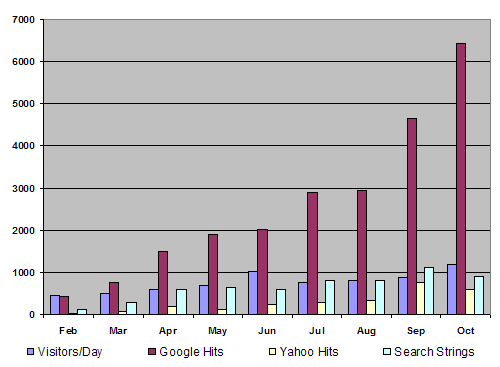
Figure 1. Monthly hits from Google (and Yahoo!) and also the total number of search strings that were used to access the content on Pearsonified.com. Note: October numbers are incomplete
Despite its relative simplicity, the above graph actually contains some very revealing details about the Google sandbox. Among these details:
- Google performed its “quarterly” index (where it assigns new page rank and includes/excludes more pages from its trusted ranks) in late February, late June, and late September. Notice how after each new index, this site saw a corresponding jump in monthly hits from Google and also in the total number of search strings that were used to access the content.
- Through June, nearly all of my Google traffic came to only five pages of this site, despite the fact that I actually had over 90 total pages. On top of that, search strings that successfully landed visitors on my site were incredibly specific.
- By the end of August, just over 20 total pages were indexed in Google, and the overall number of Google hits evidence the fact that there was more meat out there for searchers to chew on. On top of that, I began to see more permutations of each search term showing up, which stands in direct contrast with the specificity I experienced through June.
- Although we’re not even halfway through October, it looks as though nearly all of my 113 pages (currently) are not only indexed in Google, but they’re also out there sending a significant amount of traffic back to this site. Oh, and as for the search strings that are getting people here? With terms like “horse face,” “bitch slap,” “hulkamania,” “ugly woman,” and “god warrior” landing people on my fine pages, it’s starting to look like a bit like a circus
A Graphical Depiction of Rising Trust
Clearly illustrating the concept of Google trust is somewhat of a vague ambition. While I’m certainly not going to claim that I’ve come up with anything novel here, I have managed to put together a graph that I think provides at least one view of how pages rise in the SERPs over time as they accumulate trust.
To illustrate the concept of Google trust, I chose to look at the frequency with which my top 20 search strings landed people on the pages of my site. In my opinion, if a search term consistently results in a successful visit to this site, then you can reasonably conclude that the landing page is also probably enjoying a higher position in the SERPs for that particular search string.
To put it another way, if you rank on page 5 for a term, you might see a couple of hits a month. By contrast, if you rank on page 1 for that same term, you might see hundreds of hits a month. In theory, page 1 results are more “trusted” than those on page 5…
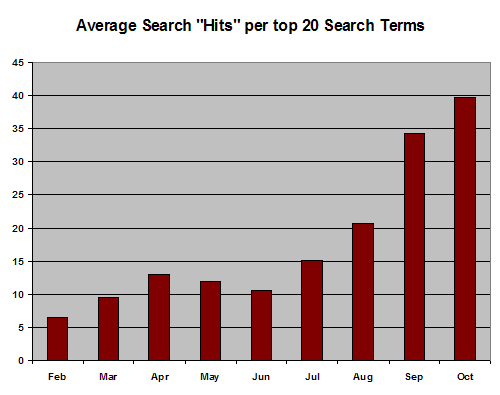
Figure 2. Graphical depiction of the average number of hits on my top 20 search terms by month. Note: October numbers are incomplete
In the Figure 1 analysis above, I explained how more and more of this site’s pages became indexed as Google performed its quarterly updates. With each successive update, I noticed more and more search terms driving people back to my site.
Figure 2 is basically Figure 1 from a slightly different angle, as it shows the frequency with which particular search terms resulted in visits to this site. Of particular note here is how the frequency has risen dramatically with each quarterly update.
While the total number of search strings (shown in Figure 1) is evidence of the fact that more content has been indexed in Google, I believe that the frequency of a particular search string (shown in Figure 2) is a great indicator of just how “trusted” certain pages of your site have become.
Although the October numbers are incomplete, I project that once all is said and done, I will see an average of 75 hits for my top 20 search terms.
Based on my those numbers, then, I can only conclude that I have, in fact, reached “trusted” status within Google.
The Bottom Line
It really is amazing how powerful Google is in terms of pushing traffic all over the Web. I have literally been wowed by the rate at which my traffic and other metrics have increased over the last two months, which is basically the time frame in which I crawled out of the Google sandbox.
In fact, now that I’m out (and a geek), I can say that getting out of the sandbox is kinda like getting laid for the first time.
It’s a phenomenal process to behold, and it’s both impressive and intriguing how much Google can shift the traffic dynamics of a Web site once it’s fully-indexed.
Now, imagine the possibilities if you were actually selling something off of all these indexed pages…
It’s a shame I hate retail so much
52 Comments ↓
No book in the works? No multicolored WP-themes based upon your cutline framework- all for the low low price of only $99.99?
All in due time, Drago.
Actually, my passions are bound to end up pushing me in the direction of publishing at least one book.
Why?
Because I’m becoming obsessed with page layouts and print designs as well, and I know that I won’t be happy until I do the layout for a book.
Might as well be my own, don’t you think?
Can’t wait for your book, Chris! It will be a instant hit, I’m sure of it because you’re not only obsessed but also passionate about what you do.
Thanks for sharing your knowledge with us!
Chris,
Some of this is a natural progression of adding content to your site as well, isn’t it? As you continue to write on new topics - you are providing additional ‘food’ for search - so the Google engine is going to continue to provide more hits back to you.
Other less industrious sources focus on site topic, name and keyword data rather than complex algorithms of content. So… since the topic matter of your site is similar with each post, they don’t push you up the chain anymore. (As well, I really don’t think that they stand a chance of gaining Search Engine Market Share).
This is, indeed, a testament to Google’s algorithms and usage. Beyond finding your site more often - they are finding the right results for the user… which is most important.
Thanks for sharing this! This is remarkable. I really enjoy your blog and your work.
Chris, you should publish a how-to-design for beginners. The code is what frustrates me, not the design part so much. Graphic Design and website design have loads in common. The code is what’s not common. Argh!
Actually I think it has more to do with switching to wordpress than getting out of the sandbox.
All I can say is its about time.
Doug: That’s the natural reaction, but I made a point in the post that speaks to the contrary.
Despite the fact that this site had over 90 pages in June, only five of those pages were receiving search traffic of any kind (at least from Google). Now, I have something like 113 total pages, and all of them appear to be indexed.
See the difference? Looks like a sandbox to me…
David: I switched to WordPress just after the most recent round of Google indexing, and more and more, it simply looks like a combination of timing and effective architecture.
The switch to WordPress helped, but I think the SEO aspects of my design (which is based on the Cutline framework, mind you) have played a much bigger role in the recent “boom.”
I’m tracking this pretty closely, and sometime soon, I’ll bust out a post with all of my “theories” on the subject…
…for the low, low price of $59.99!
That’s all 59.99 wowzers charge 99.99 and give us a free t-shirt and im sold.
Oooh, I like the idea of designing a cool t-shirt, too.
Damn, I gotta get on the merch!
Chris, Photoshoping a t shirt seems pretty simple of course, there are lots of funky slogans and tag lines you could come up with.
Keep on rockin’ . Loving Cutline btw.
Nice article, just one thing to pick: ‘Google performed its “quarterly” index ‘
That isn’t really true. Google updates the public value of PageRank once a quarter, but internally they update the value constantly. The same applies (from my experience and other evidence) that trustrank is also continually updated. In fact, by the time you get the public PageRank, that value is already old (to Google)
Hey Chris, first of all thanks for the cutline theme - it rocks. Second I am a little shocked you are looking for visitors searching for “getting laid for the first time”
I’m a savvy Webtrepreneur…whaddya expect?
a line graph of google-referred site visits per day would be interesting to see.
[...] There have been many reports about the Google Sandbox over the ages of blogging, but recently Personified has put up a great graphical look at leaving the Sandbox, and I thought the article deserved to be featured here. It really is amazing how powerful Google is in terms of pushing traffic all over the Web. I have literally been wowed by the rate at which my traffic and other metrics have increased over the last two months, which is basically the time frame in which I crawled out of the Google sandbox. [...]
I’m thinking a video series on how to mod out Cutline would sell more copies than a t-shirt and would jack up the number of users, thereby jacking up the number of incoming links, thereby …
Am I rich yet?
How long after the quarterly ranking mission, does it take to show on a if there has been any changes in the page rank?
Steve,
It happens pretty quickly. Copyblogger, for instance, went from PR 5 to PR 6 on October 3rd.
I’m sure there’s some variance there thanks to DNS propagation, but for the most part, visible Page Rank changes take place shortly after the quarterly index.
Actually, according to Ahmed, the only update that could really be considered quarterly is the PR update.
To some extent, I agree that new pages get indexed on a more liquid basis, but I think trust goes up quarterly along with PR. I have seen far more permutations of keyphrases resulting in traffic to this site after each quarterly index, and I’m not inclined to believe that it’s coincidence.
The only problem with your metaphor is that you don’t get pissed if some Googles your girlfriend.
chris,
i want to work with you on a project and have you do the design… this is totally legitimate and i promise 1000% over when you hear the details you are going to be PSYYYYYYYYYYYYCHED to get on board..
but i need your e-mail address.. please e-mail it to me at britwolfson[at]gmail[dot]com
thank you
http://www.britwolfson.com
http://www.myspace.com/britisme (clips of me dancing)
http://www.elasticillusion.com
First I must say I am MOST impressed by your web site design and I love how you share your metrics and info on how you’ve improved your site. I just started 3 months ago and have switched domains NO LESS than 2 times so it is tough for me to rely on search engines for traffic. Right now most of my traffic is from the news sites where I submit my articles and the RSS readers.
Again GREAT job on your blog, its design is fantastic.
Hi - what a brilliant article - it explains so much - my site is 20 months old now and the traffic from Google is spasmodic - some months good, some bad - but I must say that this month it’s looking better - #2 to msn now and it’s been #3 with Yahoo at #2 - hopefully I’m on my way out of this sandbox thing now.
Hey- I can’t find your email address anywhere. Can you drop me a line?
Thx a lot for this very informative article. Can you tell us what Google rank positions you’ve had over the time from february till now? Thx in forward.
“Getting out of the sandbox its like getting laid for the frist time” jajjajaj that way funny dude.
This whole pagerank thing can get you all worked up. Actually what you see as a pagerank might be the pagerank in one of the many servers google have. Actually a few months back my blog had a Pagerank of 7. I was surprised. But now my pagerank has dipped to 5. Then I went to this site http://www.seologs.com/pr-check/pagerank-dc.html. This site tells your page rank in the various server that google has. I took the liberty of checking your pagerank and your site is still not indexed in few of the servers. And i love your layout.
Chris, I have a few questions for you:
1.Why does it seem like many sites get out of the sandbox at the same time?
2.Does the sandbox apply to existing older sites?
Thank you.
Agora,
A lot of sites seem to emerge from the sandbox at the same time because of Google’s quarterly indexing.
I realize this is somewhat controversial (and it’s already been refuted in the comments), but based on the statistics I’ve compiled from the past year, I have every reason in the world to believe that there is at least some correlation between search engine referrals, traffic, and quarterly indexing.
I think the answer to your second question is contextual in nature. If a site is old but has never had enough content to truly get indexed, then yeah, I suppose the sandbox would apply to it. However, if a site has been ranking in Google for some time, then there is a much greater likelihood of new material showing up quickly in SERPs.
All in all, I think the whole idea of the “sandbox” is somewhat misleading. It’s not nearly as concrete as it’s been described here — in fact, it appears to be a much more evolutionary, liquid kind of thing.
I do believe, though, that Google probably institutes little algorithm tweaks each quarter, and in the process, they probably also audit all of their existing info.
After all, it makes sense to trash older, less relevant content in favor of new stuff, and these quarterly shifts seem like a pretty reasonable way to handle a task like this.
Great information. Thanks!
Also, I have a question regarding this subject. Our blog drives traffics to other blogs by sharing their contests in one central place. We’re getting a fantastic response from the blogging community and we believe our site can be very successful, however, we’ve been deleting the contest posts after the deadlines expire. It seems pointless to have a multitude of contests listed on the site that no one can enter.
But, what will this do in terms of how Google looks at us? Should we keep the posts archived in some way?
Any advice would be appreciated.
[...] You can follow any responses to this entry through the RSS 2.0 feed. You can leave a response, or trackback from your own site. Leave aReply [...]
[...] The last time I spoke about SEO, I attributed my recent traffic surge to this site’s emergence from the Google sandbox. Now that I’ve had a chance to further analyze my data from October, though, I think that I may have been at least partially incorrect in my views on the sandbox. [...]
My site contains a lot of competitive phrases so I am going to be in the box for a while but meanwhile you’ve got a very nice layout on your site.
Great article. I have a new blog and new to all these things like “Sandbox.” Your article demonstrates well as to what can I expect. As a matter of fact the Google search traffic is increasingly linearly and I am in month 3 of blogging.
Curious if you have insights into pagerank as well. How long does it take to get something beyond zero. Would appreciate your thoughts on it.
MillionDollar,
In February of this year, Pearsonified pulled a PR 5 after being online for just over three months. I saw other sites garner similar results over that same time frame, as well.
Because of this, I feel like any site that operates for 3 months and garners 20–50 inbound links from other sites will likely pull a PR 5. At the very least, I would expect you to pull a PR 4, especially if you post around two times per week.
To be honest with you, though, I think PageRank is a pretty meaningless metric at this stage of the game. In fact, it’s almost a popularity thing now — like, check out my cool points, yo.
Don’t worry about PR. Crank out good content, make sure your architecture is solid, and you’ll rank like a champ!
Chris,
Wish you a great 2007. Thanks for the insight. Much appreciated.
Quick question, great post by the way… I did a quick whois on personified and it was created in 2005, based on the date of this post, are you saying it took nearly a year to get out of the sandbox? Do you think your other efforts had any effect on digging you out?
Zach — From month 9 through month 11, this site emerged from the sandbox, and my number of monthly inbound search terms jumped through the roof (further proof of this here).
To be honest, I think that some of the moves I made (like switching to WordPress so I could optimize every page of my site) resulted in more “discoverable” content. It’s somewhat unfortunate that I made a major architectural change about halfway through the 10th month of this site’s existence, because that time frame was also coincident with its emergence from the sandbox.
Despite that, I still believe that you cannot reasonably expect to rank well for key phrases if your site is less than nine months old.
I realize that a lot of people get pretty discouraged when they see that “freedom” is nearly a year down the road, but those same folks are going to learn a lot of invaluable lessons about running effective Web sites in that same time frame.
There are no “easy money” answers with the Web. The cream rises to the top, and it takes time and effort to create good cream.
Finally someone has explained this clearly !
Thanks again!
Chris, I forwarded this article to someone who is experiencing the sandbox for reference. One thing is did you notice that certain terms were sandboxed while others were not.
Also on a sidenote. Did those folks who bought Cutline also get this website in the deal. Still loving the Cutline. Thanks for all your work on it.
Dave — In Figure 1, you’ll notice that the bars are very short in the beginning, and then there is steady growth through September, which is when I think this site completely emerged from the sandbox.
On the left side of that graph (where the bars are short), most of those searches are on longtail terms and 3 or 4 word (or more) phrases. Here’s an actual example from this site, pre- and post-sandbox:
In most cases, the more words involved in a search string, the more long tail it is. When your site is emerging from the sandbox, your search profile will likely consist of a bunch of outlying “fringe” terms. However, once your site comes out of the sandbox, you’ll begin to see a much higher percentage of your searches coming from core terms and phrases—you know, stuff that people actually search for.
Chris,
Some people say that there is no such thing as google sandbox and it is just a mathematical algorithm.
Every where on the net all we hear is “Google Sandbox”
i have been reading all about Google Sandbox on wikipedia
“The Sandbox Effect is the theory that websites with newly-registered domains or domains with frequent ownership or nameserver changes are placed in a sandbox (holding area)”
http://en.wikipedia.org/wiki/Sandbox_Effect
“The Sandbox Effect is a topic of hot debate among those interested in search engines and search engine optimization. There are many different opinions about it, including the view that the Sandbox Effect doesn’t actually ”
Chris you could not have been any clear well explained post with great graphics Thanks
I agree that Sandbox in reality - to my beleive is nothing more than a very sophisticated mathiematical algorithm.
Hey - Which template is this blog on.
And more importantly can I download it - It totally rocks!
Sudhir — I made this one for myself, so it’s not available for download
Hi Chris,
Thank you for that.
Firstly let me congratulate you on creating some of my favorite themes on Wordpress.
I’ve been having some trouble with the ‘Cutline’ theme of yours. I would like to ideally rename the pages to pages of my choice ( Eg. Articles, Podcasts) as they are relevant to me. I’m a journalist, I write for a newspaper in India and run a podcast show and would ideally like to run parallel pages on my blog containing content related to these two facets.
What I find with both the Cutline and Pressrow themes is that, the pages I create don’t show up on the homepage and instead go into a different sub-category. How do I address this?
When I host the blog directly on wordpress - I don’t find this to be a problem. For instance sudhirsyal.wordpress.com is just the way, I want it. But as it won’t support plug-ins is not to my preference.
Would be great if you could help me out with this.
Thanks,
Sudhir
shit, I need to get laid man, I haven’t experienced the Google orgasm yet. I only get 20 hits average from the 60 and something pages indexed in Google from my site. probably i’m sandboxed to hell, my site is only a month old.
Chris,
I graduated from college with a degree in Graphic Design almost a year ago, and I was not told a single thing about SEO in all of my education. Now that I’ve been hired by a management company, and asked to design their website, I’ve felt at times like I’m in over my head with all of this, but thanks to people and sites like your’s, I finally feel like I might be starting to get a grasp on the in’s and out’s of SEO. Thanks for everything, and keep up the good work.
As a new hand to website design and SEO, this article both enlightens me and scares me a lot at the same time. Glad there’s at least a few people like you out there to relay some of this sort of information at no cost. Keep up the good work
Very useful and interesting website , especially for me because i bought my new domain only 2 months ago , so i am in sandbox and it was interesting article about this effect. Thak you very much.
great that u have so many cache pages and great experience for all fo us to learn from ur experimentation. hope we get such good resulsts as u do .
Hoot and/or Holler ↓